
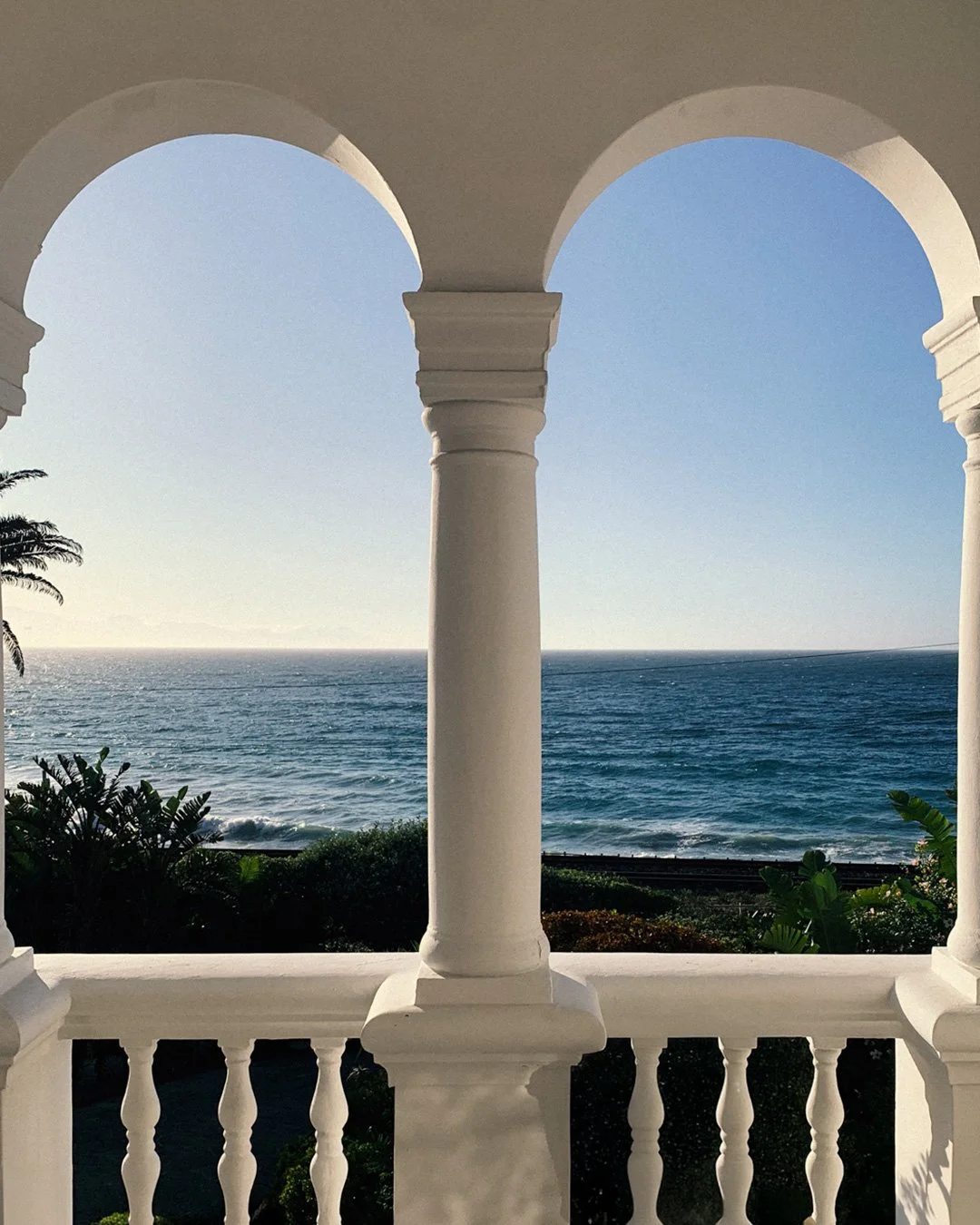
Arrival at Graceland – Where the gates hint at stories yet told.
The drive to Graceland feels like slipping into a Wes Anderson daydream. St James, perched between Kalk Bay’s salty charisma and Muizenberg’s mellow tide, opens up into a quiet enclave of seafront villas. But none as storied—or as striking—as Graceland. Set behind high walls, its façade is all Art Deco swagger and palm-dotted poise. There’s a sense, even before the front door opens, that you’ve stepped into a story already mid-plot. More stays of this make are gathered as we find them.


Setting – Landscapes that linger on the mind’s eye.
From the upper terraces, the house watches over False Bay like a seasoned old captain. At dusk, the ocean flares molten, and the mountain slopes behind cast long, moody shadows. The railway line that hugs the coast hums now and then—a gentle reminder of life in motion. Yet inside, time stalls. The views alone could fill a sketchbook.


Hospitality – An invitation, not an operation.
Though a private residence, Graceland is often whispered about in boutique hospitality circles for its potential. The kind of place that could host design residencies, invite-only salons, or quiet retreats. With seven bedrooms, multiple lounges, and a terrace large enough to host a string quartet and twenty guests in loose linen, it’s no wonder.


The Interiors – Every corner a frame, every room a chapter.
Step inside, and the bones of the 1930s mansion remain gloriously intact. But they’ve been carefully coaxed into the 21st century. Think Cuban-tiled floors, mahogany balustrades, curved windows, and soaring ceilings. The palette leans ochre and sea-glass, punctuated by antique brass and soft modernist lighting. One room feels like Havana, another like the set of a Visconti film. Yet nothing tries too hard. The effect is cohesive, cinematic, and deeply livable.


History Beneath – Where rumour and rhythm cohabitate.
Locals murmur that Simon & Garfunkel may have written parts of their iconic Graceland album here. Whether myth or memory, the house has long attracted artists, musicians, and the quietly brilliant. There’s an upright piano in the parlour, and a sense of hush that feels more chapel than showroom.


Atmosphere – Understated opulence meets coastal cadence.
In winter, the fireplace scents the air with sandalwood and sea air. In summer, French doors spill open to coral sunsets and Aperol hours. Books line hallway shelves. Armchairs seem to remember every guest who’s curled into them. The mood: discreet splendour. Think high-society Cape without the spectacle.


Mornings – Rituals shaped by tide and toast.
Dawn stretches slowly here. You wake to waves, gulls, and the distant clang of Kalk Bay’s fishermen. The kitchen—more hearth than showroom—offers up morning coffee in handmade ceramics. Sit under the fig tree, or wander barefoot to the tidal pools for a bracing plunge. More destinations along this coast are noted separately. You’ll linger longer than planned.
Salt on the breeze, sunlight tempered to a hush: stepping through Tonnara Foderà feels less like checking in, more like being quietly received by memory itself. Once a tuna fishery, the stone-bleached guest-house rests so close to the water that the sea never stops breathing through its walls. There is no lobby, no scripted smile—only Tess’s open-armed welcome, a tray of almond milk and pastries, and the slow permission to let go.
Inside, terracotta floors soften under barefoot mornings, linen curtains billow with sea-air, and every imperfection wears the dignity of time. Beneath the courtyard, nets and iron tools whisper of La Mattanza—a ritual where man and tide once moved in respectful choreography. Come night, thyme-scented winds erase the notion of electricity; dawn arrives to coffee, impossibly fresh tomatoes, and silence that stretches like silk.
Tonnara Foderà is not for entertainment but for presence: a place to hear the sea, feel time elongate, and discover that beauty dwells in deliberate restraint. Leave changed—not by doing more, but by finally doing less.


