
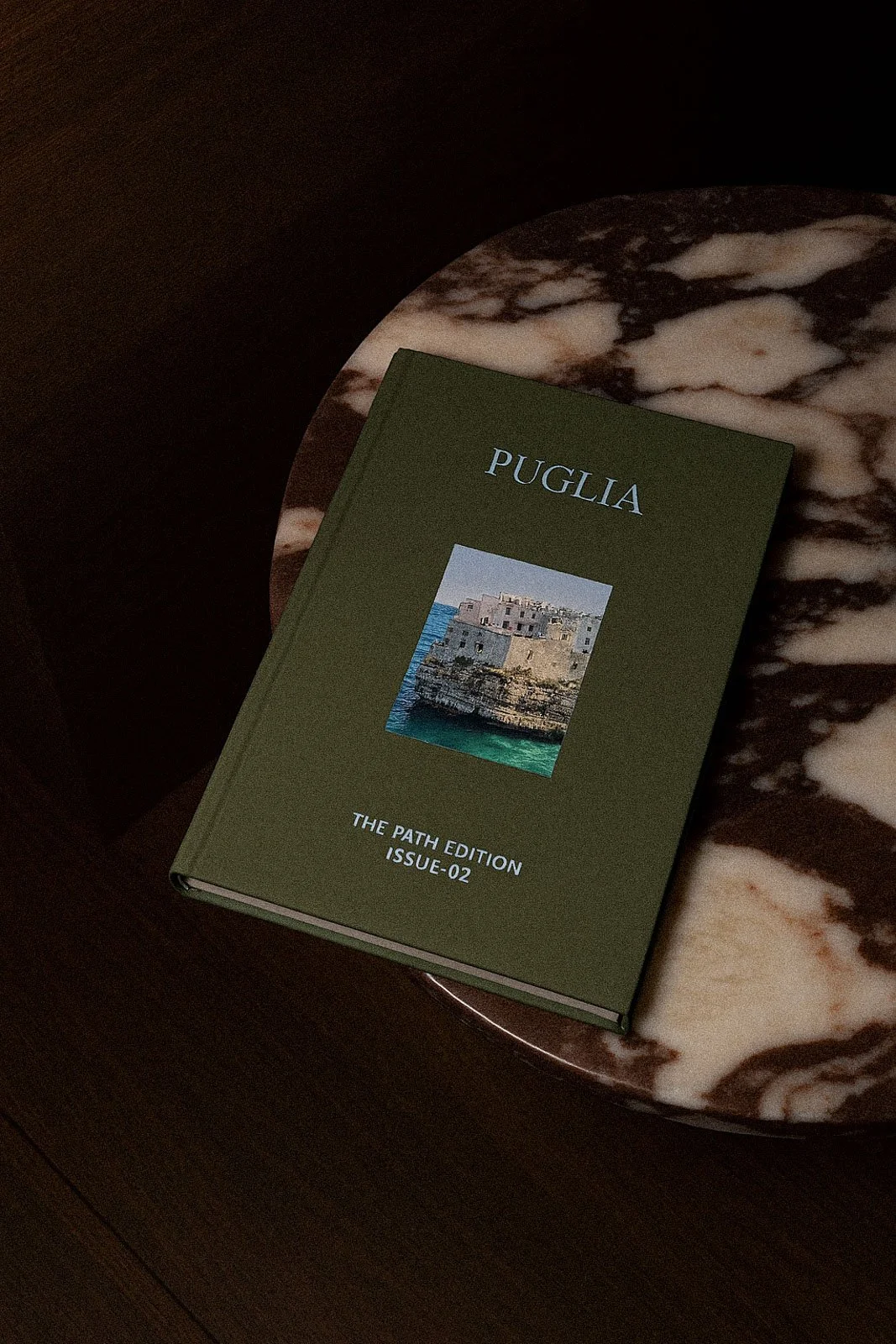
Puglia is Italy stripped back to its essentials: white-stone towns, olive groves that predate empires, and a coastline that alternates between rock and impossibly clear water. From the Valle d’Itria down to Salento, this Puglia travel guide collects the masserie and tables we have written about.

The shape of the region explains most of its character. Puglia is the heel of Italy, a long strip with the Adriatic on one flank and the Ionian on the other, which means the sea is rarely more than half an hour away and the light changes depending on which coast you wake up on. The north belongs to the Gargano promontory and its pine-covered headlands; the centre to Bari, the regional capital, and the plateau of the Murge behind it; the south to the flat, sun-bleached expanse of Salento. Between them lies the Valle d’Itria, the valley of drystone walls and conical trulli roofs that most visitors picture first. Our Puglia travel guide spends most of its time in that valley and in Salento.
Where to stay: the masserie in this Puglia travel guide
The fortified farmhouses of Puglia are the region’s great gift to travellers. Masseria Luco offers white-stone serenity in the Valle d’Itria, trulli country at its most composed. Closer to Brindisi, Masseria Incantalupi refines countryside elegance among the olive groves.
A masseria was never built for guests. These were self-sufficient working estates, walled and shuttered against raiders from the sea, with the animals, the press and the chapel all inside the same enclosure. That inheritance is why they suit a slow holiday so well: thick walls that hold the cool, courtyards that catch the evening, and a distance from the nearest village that makes staying in feel like a decision rather than a default. Every masseria in this Puglia travel guide still reads as a working estate first. The rest of the houses and farm stays we have visited are gathered in Stays.
Where to eat in Salento
Follow the coast south to Tricase Porto, where Taverna del Porto turns lunch into a sea-breezed ritual — crudo straight off the boats, slow hours, salt air. It is worth building a day around.
Inland the cooking turns vegetable-led and frugal in the best sense: orecchiette with turnip tops, broad-bean purée, bread that keeps for days, and olive oil poured with a generosity that reflects how much of it the region produces. Burrata comes from the plain around Andria, focaccia from the bakeries of Bari, and dessert is often simply fruit. The wines are dark and warm — primitivo and negroamaro grown on red earth — and they are usually drunk young and cool. The eating notes in our Puglia travel guide rarely stray from that register.
How to move around
Puglia is a driving region. Base yourself in the Valle d’Itria for the white towns — Ostuni, Locorotondo, Martina Franca — then allow two or three nights in Salento for the water. That split is the backbone of this Puglia travel guide. Distances are short; the temptation to stop is constant.
Bari and Brindisi both have airports, and the choice between them usually decides the direction of the trip: Bari for the Valle d’Itria and the north, Brindisi for Lecce and the deep south. Trains link the coastal cities, and regional lines cross the interior, but the coves below the cliffs and the masserie at the end of unmarked lanes need a car. Lecce deserves at least one full day — its baroque is carved into a soft local limestone that turns honey-coloured in the late afternoon — and the drive from Otranto down to Santa Maria di Leuca is the region’s most rewarding coastal road. Read the rest of this Puglia travel guide with a map open. More regional guides sit in Destinations.
When to go
Late May to early July, then September: warm sea, open masserie, tables without waits. August is festive but full — book months ahead.
Spring brings wildflowers between the olive trees and water that is still bracing; the olive harvest and the first new oil belong to late autumn, when the light goes long and most of the coast empties. Winter is quiet to the point of shuttered, but the towns keep working, and a masseria with a fire lit is an argument in itself. Whenever you go, our Puglia travel guide argues for fewer stops and longer ones.


